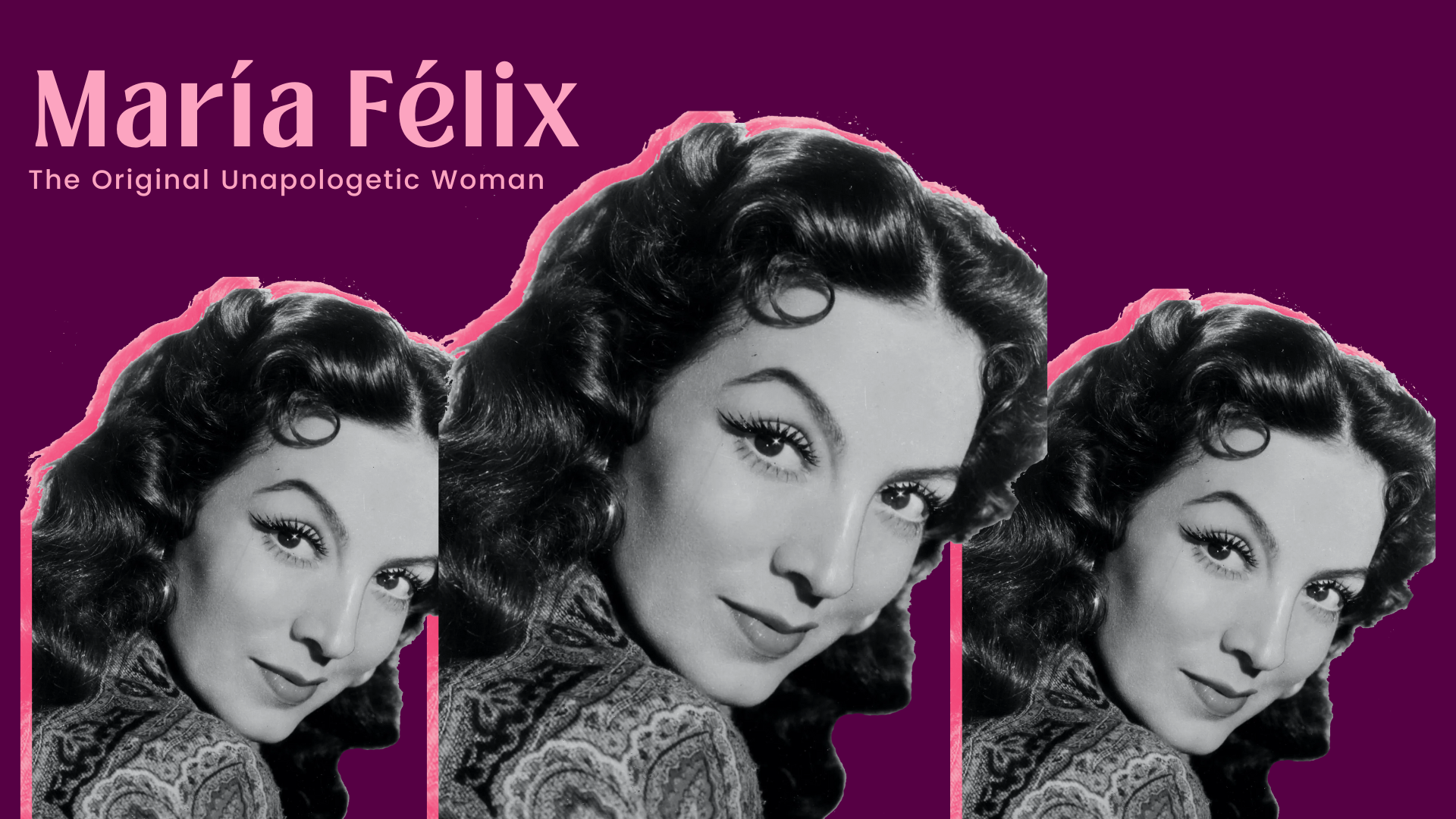
Why did it take me forever to write about María Félix, La Doña? I have no idea but here it is. Let’s get into it!
When we talk about unapologetic women in history and in today’s case, Mexican history, one name rises above the rest: María Félix. Known as La Doña, she wasn’t just a screen goddess; she was a cultural force, a woman who rewrote the rules of femininity with her personality, wit, elegance, and a wardrobe that could rival any modern-day fashion icon.
So let’s discuss her fashion legacy and the fearless philosophy that made women admire her unapologetic self.
A Brief Look at María Félix
Born in 1914 in Sonora, Mexico, María Félix rose to fame during the Golden Age of Mexican cinema, starring in iconic films like Tizoc (1957), Enamorada (1946) and Doña Bárbara (1943), which made her a legend across Latin America and Europe. But beyond her on-screen brilliance, it was her personality—sharp, commanding, and utterly magnetic—that turned her into an eternal icon.
And, truth be told, unlike other stars who were content with playing the ingenue and “submissive” character, María played herself: a woman who owed nothing to anyone.
Her Unapologetic Philosophy on Life and Love
María Félix wasn’t afraid to challenge the societal expectations of her time. She lived on her own terms: fiercely independent, discerning in love, and vocal about women’s worth. She famously said:
Protesten, quejense, no se dejen, prepárense, hagan de su vida lo que ustedes deseen y no lo que sus hombres les permitan ser. Amen y háganse amar. No se conformen con poco. Este será de hoy en adelante un país de mujeres. Ahora nos toca.
(Protest, complain, don’t give up, prepare yourselves, and make your lives what you want them to be and not what your men allow you to be. Love and make yourselves loved. Don’t settle for less. From now on, this will be a country of women. Now it’s our turn.)
In each interview she gave, she would constantly encourage women to be more independent, secure, themselves… And even though she was married four times, she was never defined by any man. Instead, she defined herself, a concept that feels more relevant than ever in today’s conversations about autonomy, ambition, and self-respect.
María Félix’s Fashion Legacy: Power in Every Stitch
Besides her strong persona on and off screen, La Doña had one of the best fashion senses I’ve ever witnessed. Yes, I’m obsessed with her.
For her, fashion was never an afterthought. It was a language, and she spoke it fluently. Her signature style combined architectural silhouettes, bold shoulders, cinched waists, and luxurious fabrics. She mastered the art of elegance with authority, proving that femininity and power could coexist gloriously.

She was often dressed by designers like Balenciaga, Chanel, Christian Dior, Givenchy and Yves Saint Laurent. Also, the House of Hermès (Couture Department) designed extravagant creations just for her. However, she was also close with Mexican designers like Tao Izzo, with whom she used to collaborate on her costume designs.
Now, her jewelry collection is the stuff of legend. Among her most famous pieces is the Cartier crocodile necklace, designed in 1975, featuring two intertwined crocodiles encrusted in yellow diamonds, emeralds, and rubies. This wasn’t mere accessorizing; it was a declaration of strength, sensuality, and individuality.
But María Félix wasn’t just a fashion icon: she was a muse, inspiring entire collections and even shaping the aesthetics of an era.
The Muse of Many
María Félix was an art lover and often an inspiration for many. She would also commission artists to paint her portrait. Some of the most famous portraits include those of Diego Rivera, José Clemente Orozco, Leonora Carrington and Tao Izzo. This last one being my personal favorite. Regardless of all artists’ personal styles, La Doña was always portrayed as her powerful and mystifying self.
Also, funny story, out of these three paintings, Diego Rivera’s was, let’s say, the one with the most hiccups. In an interview with Mexican journalist Jacobo Zabludovsky:
I have never liked Diego Rivera’s painting. This is not a criticism I make behind his back; I told him so myself. I wanted him to paint me as a Tehuana, but he said it was too vulgar and refused. So he painted me how he wanted, almost naked, because he was in love with me, so he painted me almost naked. He wanted that portrait for an exhibition at the Palace of Fine Arts, but I didn’t lend it to him. He called me all sorts of names, insulted me, and didn’t speak to me again for a year… Then one day, there was a builder upstairs, and I asked him to paint the nude parts white, and that’s how Diego’s original looks now. The builder was very scared and covered up the nude parts with paint from the house. Why not? It looks better now.


María Félix, La Doña, was more than a movie star; she was a manifesto. She was living proof that elegance can coexist with strength and that women have every right to be powerful, take up space, and live unapologetically.
Her legacy isn’t just in black-and-white films or Cartier archives; it’s in the lessons she left behind for every woman to live without asking for permission to be themselves. She will forever be part of Mexico’s history and an icon for women out there living their true selves.


Leave a Reply